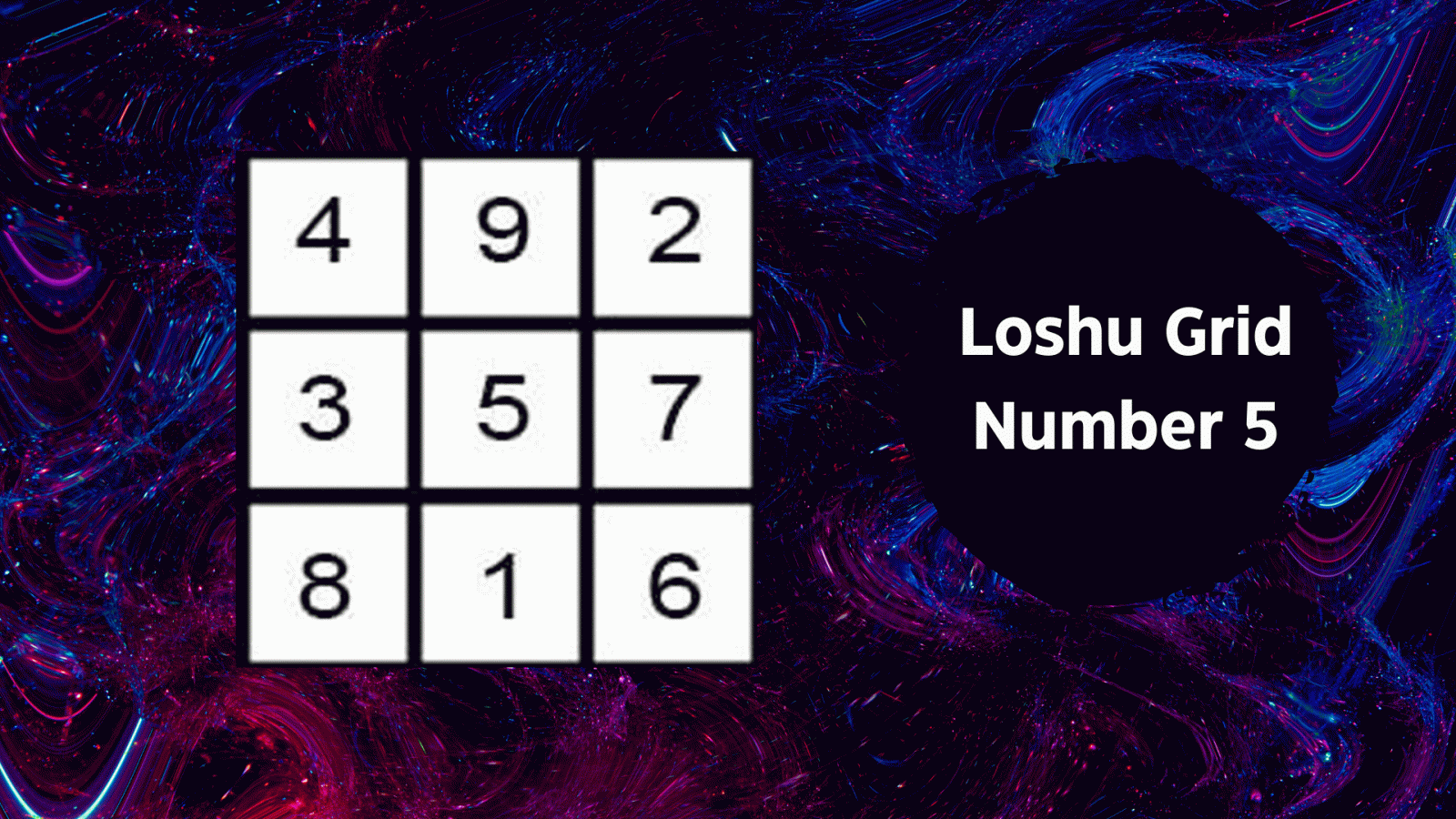
Number 5 in the Lo Shu grid is the number of balance, movement and adaptability. The Lo Shu grid is a 3×3 square with a fixed layout: 4-9-2 on top, 3-5-7 in the middle and 8-1-6 at the bottom. Every row, column and diagonal adds up to 15.
Number 5 always sits in the centre box. There is no “5 in another cell”: every number has one fixed box. In Indian numerology 5 is ruled by Mercury (Budh), and in Vastu the centre of the home is the Brahmasthan.
In short: 5 is the only number that shares a line with every other number in the grid. If 5 appears in your grid, you usually adapt well to change. Two or more 5s add drive and a love of freedom, and a missing 5 can make balance and follow-through harder.
Why number 5 is always in the centre
| Aspect | Number 5 |
|---|---|
| Box | The centre. Every 3×3 square of the numbers 1 to 9 whose lines all add up to 15 has 5 in the centre. |
| Direction and element | The centre of the home (Brahmasthan in Vastu), and the element Earth. |
| Planet | Mercury (बुध), linked with speech, trade and quick thinking. |
| Planes | Four of the eight planes: the Emotional plane (3-5-7), the Will plane (9-5-1), the Golden yog (4-5-6) and the Silver yog (2-5-8). |
| Opposite pairs | The numbers facing each other across 5 always add up to 10: 1 and 9, 2 and 8, 3 and 7, 4 and 6. |
| Simple maths | 5 is the middle of the numbers 1 to 9, and the magic sum 15 is three times 5. |
5 is not on every line. The top and bottom rows (4-9-2 and 8-1-6) and the left and right columns (4-3-8 and 2-7-6) do not contain it. But because it sits on four lines, a missing 5 leaves four planes incomplete, more than any other number.
What number 5 means in your grid: once, repeated or missing
| How often 5 appears | What it is usually read to mean |
|---|---|
| Missing | Balance and follow-through can be harder. Finish one task before starting the next. |
| Once | A balanced 5: you adapt to change and keep things moving. |
| Twice | Repeated 5s add drive and a wish for freedom. You enjoy variety and travel. |
| Three or more | The drive is very strong. Watch for impulsive decisions, and pause before big choices. |
| Strengths | Communication, versatility and business sense. |
| Watch for | Restlessness and inconsistency. |
These readings match what the Lo Shu grid calculator shows for your own date of birth.
Worked example: how the Indian method can add a 5
A 5 is often missing from the date digits. In the Indian method, your Mulank (Moolank) or Bhagyank can bring it in. Here is an example:
- Date: Arjun was born on 23-06-1987. His digits are 2, 3, 0, 6, 1, 9, 8, 7. There is no 5, and the 0 is skipped.
- Mulank: 2 + 3 = 5.
- Bhagyank: 2 + 3 + 0 + 6 + 1 + 9 + 8 + 7 = 36, and 3 + 6 = 9.
- Indian method: his Mulank adds a 5 to the centre, and his Bhagyank adds a second 9. Only 4 is missing, and five planes are complete: Emotional (3-5-7), Practical (8-1-6), Will (9-5-1), Action (2-7-6) and the Silver yog (2-5-8).
- Classic method: with the date digits alone, 4 and 5 are missing, and only the Practical and Action planes are complete.
The difference between the two grids is mostly the 5. Adding one number in the centre completes three more planes. This is why numerologists pay close attention to the centre box, and why it matters which method a reading uses.
Number 5 in relationships and compatibility
| Number 5 | Compatibility and relationships |
|---|---|
| In your grid | People with 5 in their grid tend to be adaptable, curious and easy to talk to. They enjoy new places and ideas, and get along with partners who give them room to move. With many 5s, steady commitments may need conscious effort. |
| As your Mulank or Bhagyank | On this site compatibility is read from your Mulank and Bhagyank, not from the grid. When 5 is one of them, 1, 4, 5, 6, 7 and 8 are good or excellent matches by the traditional planet friendship table, 2 is average, and 3 and 9 are less easy. “Less easy” means more understanding is needed, not a bad match. |
Communication, shared values and life experience matter just as much in a relationship. The numerology compatibility calculator compares two dates of birth if you want to see the full score.
Remedies if number 5 is missing
These are commonly suggested practices, not promises of a result:
- Build the habit: finish one task before starting the next.
- Keep the centre open: in Vastu terms, keep the centre (Brahmasthan) of your home open and free of heavy furniture or clutter.
- Make room for balance: plan a little variety into your week, such as a walk, a new route or a short trip, so that routine does not feel stuck.
- Gemstones only after a chart check: some numerologists suggest emerald (Panna), the stone of Mercury. A ratna strengthens its planet, so wear one only after your chart has been checked. Green aventurine is a gentler crystal choice, often kept on a work desk or shop counter.
All nine numbers are covered in missing numbers in the Lo Shu grid and their remedies.
Frequently Asked Questions Related to Lo Shu Grid Number 5
What does the Lo Shu Grid Number 5 represent?
In numerology, number 5 stands for adaptability, quick thinking and a curious, restless spirit. It is ruled by Mercury (Budh). In the Lo Shu grid it always sits in the centre, and in the Chinese and Vastu traditions the centre is linked with the element Earth and with balance.
Can individuals with Lo Shu Grid Number 5 become easily bored?
They can. People with 5 in their grid, and especially those with two or more 5s, enjoy variety and may lose interest in repetitive work. Varied tasks, travel and new skills keep them engaged. With three or more 5s, the advice is to watch for impulsive decisions.
Can the Lo Shu Grid Number 5 change over time?
No. Your Lo Shu grid comes from your date of birth, so the number of 5s in it stays the same all your life. A missing 5 can still be balanced with habits, such as finishing one task before starting the next.
Conclusion
Number 5 always sits in the centre of the Lo Shu grid and is ruled by Mercury. It lies on four planes and faces every opposite pair across the centre, so a present or missing 5 changes the grid more than any other number. In your grid, 5 is read as adaptability, repeated 5s as drive that needs a pause before big decisions, and a missing 5 as balance to build.
Draw your own grid in both methods and see whether your 5 comes from the date or from your Mulank or Bhagyank. Read the grid together with those two numbers for a full picture.
← Previous: Lo Shu Grid Number 4 | Next: Lo Shu Grid Number 6 →
Back to: Lo Shu Grid guide
Also read: Mulank (Moolank) 5, for people born on the 5th, 14th or 23rd.