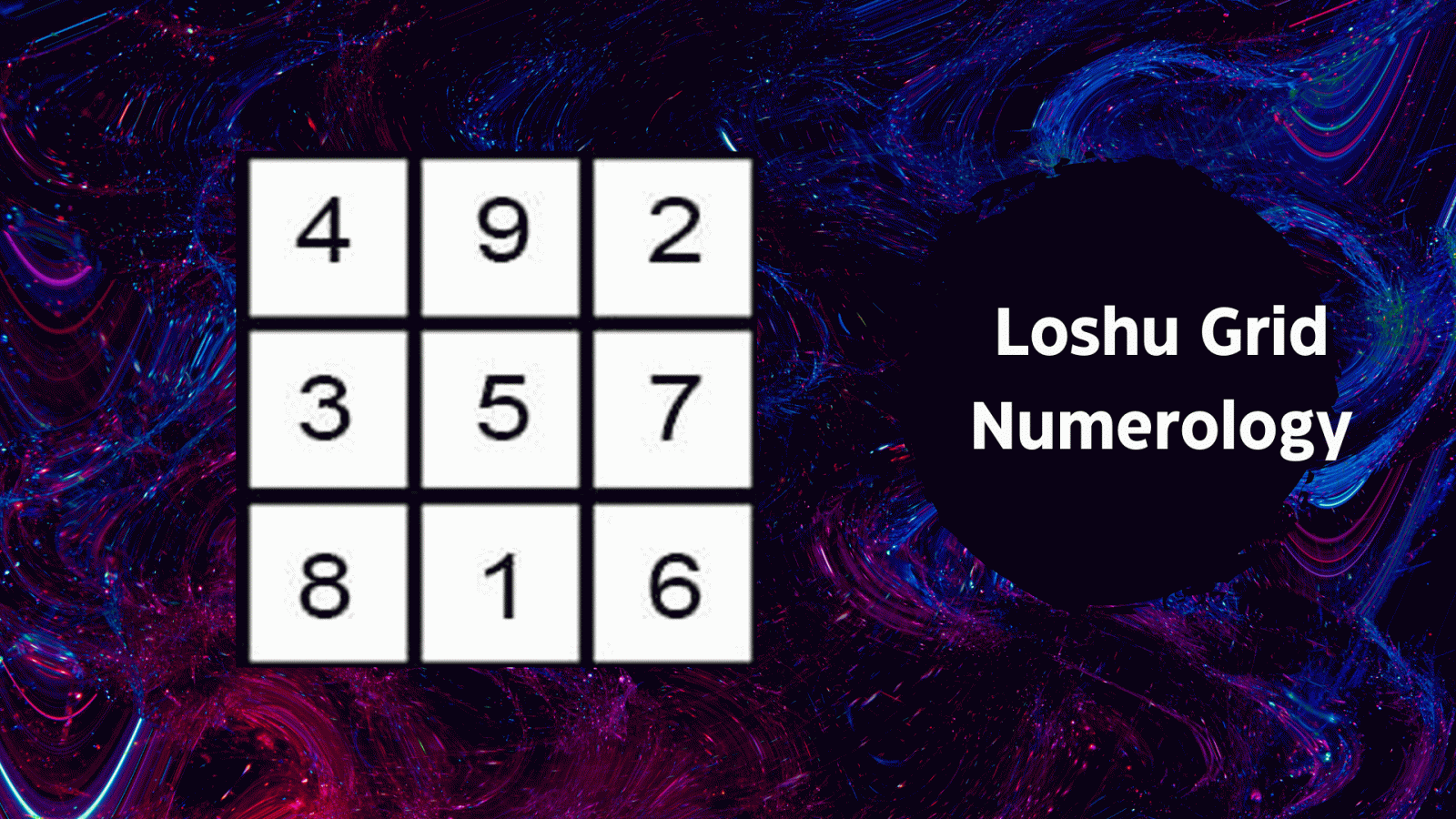
The Lo Shu grid is a square of nine boxes, three by three, filled with the numbers 1 to 9. It comes from ancient China and is also called the Lo Shu square or the Nine Halls Diagram. Each number has its own fixed box, and every row, every column and both diagonals add up to 15.
The layout never changes. The top row is 4, 9, 2. The middle row is 3, 5, 7. The bottom row is 8, 1, 6. Check any line: 4 + 9 + 2 = 15, 9 + 5 + 1 = 15, 4 + 5 + 6 = 15.
In short: in numerology, the digits of your date of birth are placed in these nine boxes. The boxes that fill up show your strong numbers, the boxes that stay empty are your missing numbers, and full lines of three are called planes.
Where the Lo Shu grid comes from
“Lo Shu” means “the writing of the Luo river”. According to legend, a turtle came out of the Luo river in China with a pattern of dots on its shell, and the dots formed this square. The best-known version links the story with Yu the Great, a legendary ruler who was trying to control the river’s floods. This is a legend, not recorded history, but the square itself is very old and has been written about in China for a long time.
A few facts about the square are simply mathematics:
- It is the only way to arrange 1 to 9 in a 3×3 square so that every line adds up to 15, apart from turning or flipping the square.
- 5 is always in the centre. The numbers opposite each other across the centre always add up to 10: 1 and 9, 2 and 8, 3 and 7, 4 and 6.
- The even numbers 2, 4, 6 and 8 sit in the corners. The odd numbers 1, 3, 7 and 9 sit in the middle of each side.
The grid is drawn with South at the top, as on old Chinese maps. So 9 (South) is at the top, 1 (North) is at the bottom, 3 (East) is on the left and 7 (West) is on the right. This is why each box is also linked with a direction of the home in Feng Shui and in Vastu. In India the grid is widely used in numerology, with each number ruled by one of the nine planets (grahas).
How numerology reads the Lo Shu grid
To make your own grid:
- Write your date of birth as DD-MM-YYYY and list every digit.
- Skip every 0. The grid has no box for zero.
- In the Indian method, also add your Mulank (Moolank), which is the day of birth reduced to one digit, and your Bhagyank, which is all the digits of the date added and reduced to one digit. The Mulank and Bhagyank calculator works these out for you. The classic method uses only the date digits.
- Put each number in its box. A number that appears twice is written twice.
- Read the result: which numbers are missing, which repeat and which planes are complete.
Worked example: Ananya was born on 14-07-1992. Her digits are 1, 4, 0, 7, 1, 9, 9, 2, and the 0 is skipped. Her Mulank is 1 + 4 = 5. Her Bhagyank is 1 + 4 + 0 + 7 + 1 + 9 + 9 + 2 = 33, and 3 + 3 = 6. This is how each number of her grid looks (Indian method):
| Number | Box | Direction | Planet | In Ananya’s grid |
|---|---|---|---|---|
| 1 | Bottom middle | North | Sun | Twice |
| 2 | Top right | South-West | Moon | Once |
| 3 | Middle left | East | Jupiter | Missing |
| 4 | Top left | South-East | Rahu | Once |
| 5 | Centre | Centre | Mercury | Once (her Mulank) |
| 6 | Bottom right | North-West | Venus | Once (her Bhagyank) |
| 7 | Middle right | West | Ketu | Once |
| 8 | Bottom left | North-East | Saturn | Missing |
| 9 | Top middle | South | Mars | Twice |
| 0 | No box | None | None | Skipped (the 0 in 07) |
So Ananya’s missing numbers are 3 and 8, and 1 and 9 each appear twice. In the classic method, without her Mulank 5 and Bhagyank 6, she would also be missing 5 and 6. The free Lo Shu grid calculator draws this grid for any date and lets you switch between the two methods. What each empty box means, and the simple remedies usually suggested for it, are explained in missing numbers in the Lo Shu grid.
The 8 planes of the Lo Shu grid
A plane is a line of three boxes: the three rows, the three columns and the two diagonals. A plane is complete when all three of its numbers are in your grid.
| Plane | Numbers | What it shows |
|---|---|---|
| Mental plane (top row) | 4-9-2 | Thinking, memory and planning |
| Emotional plane (middle row) | 3-5-7 | Feelings, balance and relationships |
| Practical plane (bottom row) | 8-1-6 | Material life, money and getting things done |
| Thought plane (left column) | 4-3-8 | Ideas and planning ahead |
| Will plane (middle column) | 9-5-1 | Determination and persistence |
| Action plane (right column) | 2-7-6 | Putting plans into action |
| Golden (success) yog (diagonal) | 4-5-6 | Read as a sign of success and recognition when complete |
| Silver (property) yog (diagonal) | 2-5-8 | Read as a sign of property and stability when complete |
In Ananya’s grid four planes are complete: the Mental plane, the Will plane, the Action plane and the Golden yog. Different teachers use the name Raj yog for different lines, so this site uses “golden yog” for 4-5-6 and “silver yog” for 2-5-8. Each number also has its own guide, starting with number 1 in the Lo Shu grid.
Number combinations: 951, 456, 258 and the others
People often look up a line by its three numbers, such as “951 in the Lo Shu grid” or “4 5 6 missing”. Each of these combinations is one of the eight lines in the table above: 951 is the Will plane, 456 the golden yog, 258 the silver yog, 492 the Mental plane, 357 the Emotional plane, 816 the Practical plane, 438 the Thought plane and 276 the Action plane. When all three numbers of a line are missing, the line is empty, and it is read through the meaning of each of its missing numbers. The Lo Shu grid calculator marks every line of your grid as complete, partial or empty, and works through a second example with three 1s, three 2s and two empty lines.
What a Lo Shu reading with Namieta covers
A calculator draws the grid. A reading puts it in context. In a consultation, Namieta looks at:
- Your grid with your other numbers: your Mulank, Bhagyank and name number, because the grid is never read on its own.
- Missing and repeated numbers: what they suggest about your habits, and which simple practices may help.
- Planes: which lines are complete, partial or empty, and what that points to.
- Your home: the Vastu direction linked with each missing number, if you want your home looked at too.
- Questions you bring: career, money or relationships, read through your numbers.
A reading describes tendencies and gives practical suggestions. It does not predict fixed events, and your grid does not change during your life, because it comes from your date of birth. The timing of a year is read separately, from your Personal Year number.
The Lo Shu grid is a simple tool: nine boxes, one fixed layout and the digits of your date of birth. Start by drawing your own grid with the calculator, note your missing and repeated numbers, and then read the guide for each number.
The grid sits alongside your other numbers. Your Mulank (Moolank) and Bhagyank each have their own page, the numerology chart calculator shows all your core numbers with the grid on one page, and our numerology guide explains how the pieces fit together.
If you would like your grid read together with your other numbers, book a consultation with Namieta.
Lo Shu grid: common questions
What is the Lo Shu grid in simple words?
It is a 3×3 square of the numbers 1 to 9 from ancient China, set out so that every row, column and diagonal adds up to 15. In numerology, the digits of your date of birth are placed in its boxes to show your strong, repeated and missing numbers.
How do I make my own Lo Shu grid?
Write your date of birth as DD-MM-YYYY, skip every 0 and put each digit in its fixed box, writing a digit twice if it appears twice. In the Indian method you also add your Mulank (Moolank) and Bhagyank. The Lo Shu grid calculator does all of this for you.
What does 9-5-1 mean in the Lo Shu grid?
9-5-1 is the middle column of the grid. This site calls it the Will plane, read as determination and persistence; some teachers call it Raj Yog. It counts as complete only when 9, 5 and 1 are all in your grid.
What does it mean if a number appears three times, like 111?
A repeated number adds weight to its qualities. Twice is usually read as a strength; three or more times can tip into excess. For 1, for example, the note is to take care not to dominate conversations.
Does my Lo Shu grid change during my life?
No. The grid comes from your date of birth, so it stays the same. What changes from year to year is read separately, from your Personal Year number.